




⚠️ Important: education and research demo only. QubitPage® OS is not a medical device and must not be used for diagnosis, treatment or clinical decisions. The drug-discovery and diagnosis tools are illustrative simulations. Their results haven't been validated experimentally or clinically.

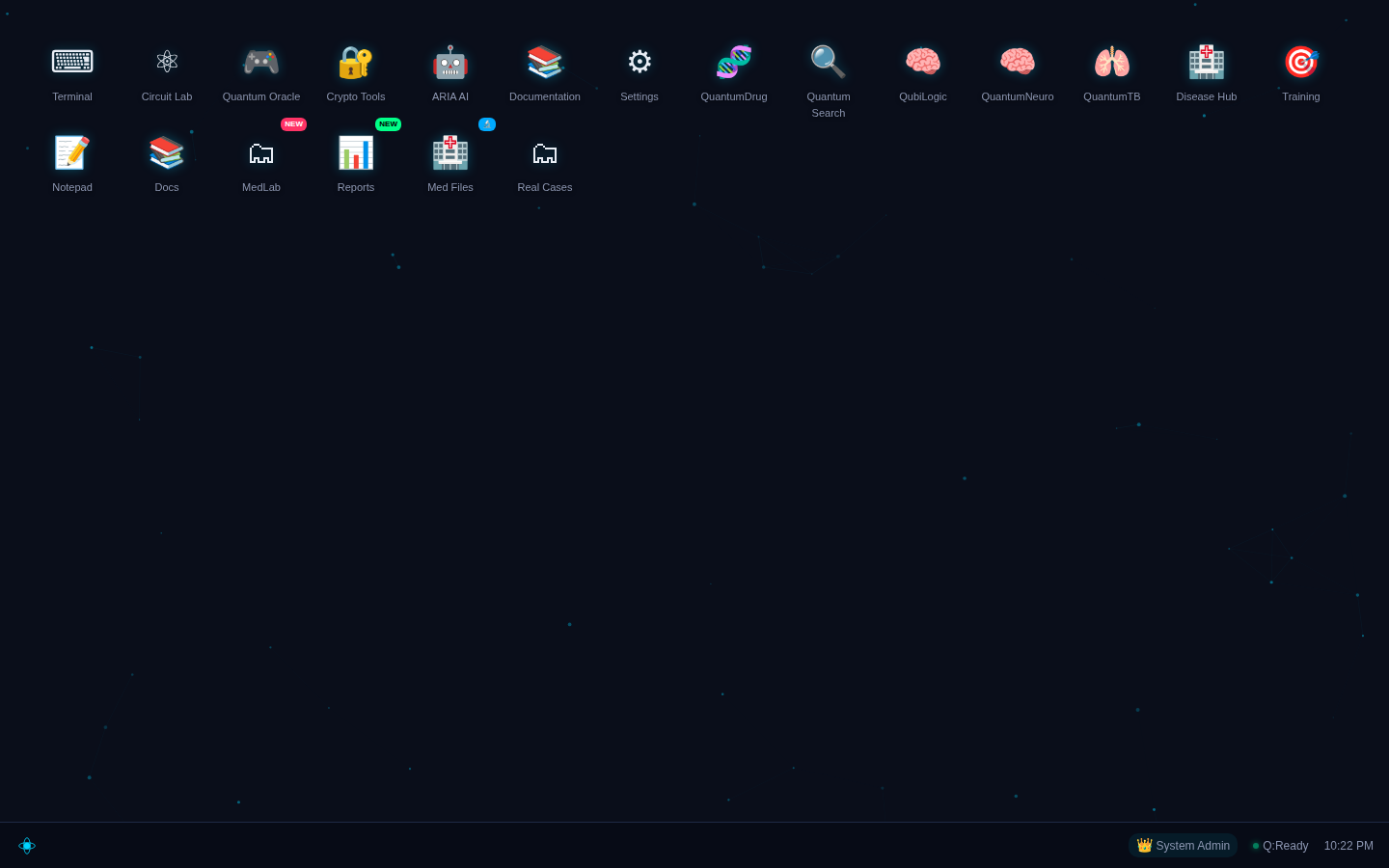
QubitPage® OS is a browser-based "desktop" (windows, taskbar, draggable icons; works on desktop, tablet and mobile) that brings together quantum-computing learning tools and AI assistants in one place:
- Quantum Terminal & Circuit Lab: write QLang commands or build circuits, and run them on the local Stim simulator
- IBM Quantum connection (optional): with your own IBM Quantum token, selected tools can submit circuits to IBM hardware through
qiskit-ibm-runtime - Textbook algorithm demos: Bell / GHZ states, Grover search, teleportation, superdense coding, BB84, entanglement distillation
- QuBIOS lab: a playground for the QuBIOS error-correction and entanglement toolkit (experimental, see its README)
- ARIA assistant: a Gemini-powered research chat built into the tools
- Medical-AI sandbox: experiments with Google's open models (MedGemma, TxGemma, Derm / CXR / Path Foundation) for learning how these models work
| Repository | Description |
|---|---|
| QubitPage-OS | ← This repo: the browser platform |
| QLang | Beginner-friendly quantum command language + browser SDK |
| QuBIOS | QEC & entanglement toolkit, simulation plus experiments on IBM hardware (report) |
Browser desktop (templates/os.html + static/js/*)
        │  REST / Socket.IO
        ▼
Flask app (src/app.py)
  ├─ quantum_kernel.py     QLang interpreter → Stim circuits
  ├─ quantum_backends.py   Stim (local) · IBM Quantum (optional, user token)
  ├─ qubilogic.py          QuBIOS toolkit (experimental)
  ├─ quantum_drug_sim.py   VQE demo on toy Hamiltonians
  ├─ gemini_orchestrator.py / ai_agent.py   ARIA assistant
  └─ med_research.py, quantummed_routes.py  medical-AI sandbox
git clone https://github.com/qubitpage/QubitPage-OS.git
cd QubitPage-OS
python3 -m venv .venv && source .venv/bin/activate
pip install -r requirements.txt

export GEMINI_API_KEY=your_key        # ARIA assistant
export GROQ_API_KEY=your_key          # optional
export IBM_QUANTUM_TOKEN=your_token   # optional; simulators work without it

python3 src/app.py                    # → http://localhost:5050
Full guide: INSTALL.md · docs/getting-started.md
| App | What it is |
|---|---|
| Terminal | QLang shell |
| Circuit Lab | Visual circuit builder; Stim locally, IBM with your token |
| Quantum Oracle / Search | Interactive Grover-search demos |
| Crypto Tools | Superdense coding & BB84 demos, AES encryption helper |
| QuBIOS / QubiLogic | QEC & entanglement playground (experimental) |
| ARIA Assistant | Gemini-powered chat |
| Quantum Drug | VQE demo on small toy Hamiltonians (see limitations) |
| QuantumTB / QuantumNeuro / Disease Hub | Disease-themed exploration dashboards built on the demos above |
| MedGemma AI / MedLab / QuantumDerm | Sandbox for open medical AI models (not for diagnosis) |
| Med Files / Reports / Training Results | File handling, report generation, experiment logs |
| Docs / Settings | Documentation, API keys, backend selection |
We want this project to be useful and trustworthy, so here is what the results do and don't mean:
- Quantum results in
models/come from simulation. Files labelledibm_fezwere produced with the FakeFez noise model + AerSimulator on a local machine, not with jobs on IBM hardware. They show the pipeline working end to end, not quantum-hardware performance. - The drug-simulation Hamiltonians are hand-written toy models. They contain only Z-type terms, so they're diagonal and can be solved exactly on a classical computer. They weren't derived from molecular structures. The "binding energies" are not real chemical quantities.
- The "drug candidates" (QBP-###) are hypotheses generated by the pipeline. They have no validated chemical structures and no experimental data. They're not drug discoveries.
- The medical image models in
trained_models/were fine-tuned on small synthetic datasets. Their high validation scores don't show real-world clinical accuracy. - The QuBIOS layer bundled here is the older experimental version. The standalone QuBIOS v1.2.2 replaces the old modelled numbers with measured ones (simulation plus IBM hardware runs; see its hardware report). The OS integration hasn't been updated to v1.2.2 yet.
- Publish real IBM Quantum runs with job IDs and raw counts
- Replace toy Hamiltonians with ones generated from real molecules (e.g. PySCF + Qiskit Nature, small active spaces) and compare against exact classical results
- Evaluate medical models on public, real, held-out datasets, with proper metrics and clear "not for clinical use" labelling
- Fix QuBIOS QEC (done in standalone QuBIOS v1.1.0+)
- Update the bundled
qubilogic.pyto QuBIOS v1.2.2
QubitPage® OS is free to try at qubitpage.com. We'd love feedback from:
- teachers who want a no-install quantum computing lab for students
- quantum / QEC researchers willing to review or contribute
- computational chemists & ML-for-health researchers who can help turn the demos into validated pipelines
📧 contact@qubitpage.com, subject [RESEARCHER] or [EDUCATOR] + your name / institution
MIT. See LICENSE. Third-party models (MedGemma, TxGemma, Foundation models, Gemini) are subject to their own licenses and terms of use.